
What Is Skill-Based Succession Planning? A Practical Guide


- Why Skill-Based Succession Planning Matters
- The Components of a Skill-Based Succession Process
- Practical Tips for Skill-Based Succession Planning
- The Role of Software in Skill-Based Succession Planning
- To Sum Up
Ask most organizations who would take over a business-critical role tomorrow if the current holder left, and the honest answer is often a shrug, or a name picked mostly because of tenure.
Skill-based succession planning replaces that guesswork with a structured comparison: what does this role actually require, and who (inside the organization) is closest to meeting those requirements right now?
Unlike a traditional “successor list” updated once a year in a spreadsheet, it treats succession as a live, ongoing view of readiness, tied to the same skill data used for everyday development.
Our skill-based succession planning software shows you exactly who is ready for what’s next, based on real skill and role data.
Why Skill-Based Succession Planning Matters
Traditional succession planning has a well-known weakness: it tends to reward tenure and visibility over actual readiness.
Single Points of Failure Are More Common Than Leaders Think
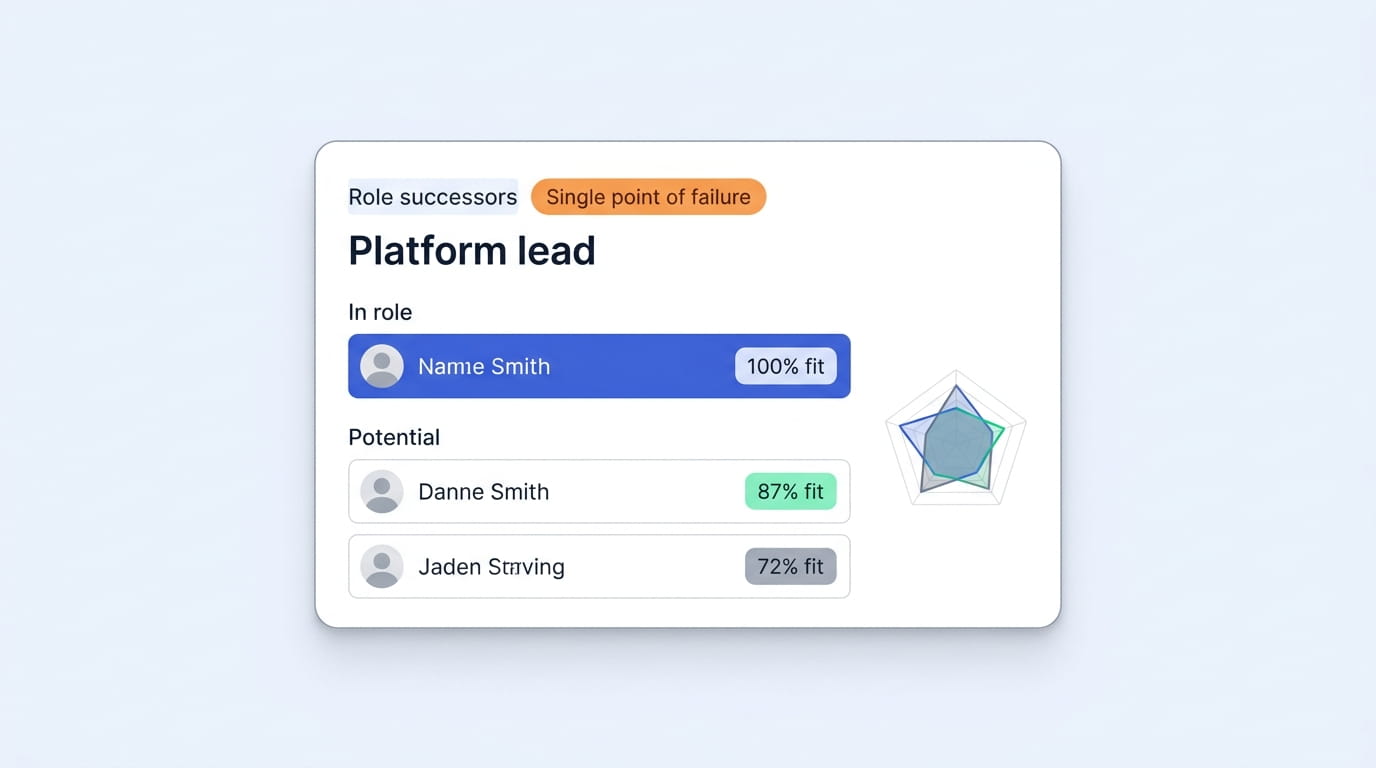
Many business-critical roles are quietly held by exactly one person, with no documented backup. That risk often goes unnoticed until the person actually leaves.
Competency-Based Succession Identifies Real Successors
Modern succession approaches identify successors using skill proficiency and job role alignment, rather than relying on subjective nominations or informal reputation.
It Protects Against Both Sudden and Planned Departures
Whether someone leaves unexpectedly or a planned retirement is years away, having a documented, skill-based view of readiness means the organization is never starting the search from zero.
It Doubles as a Development Tool
The same gap analysis that identifies a successor also identifies exactly what they still need to develop, turning succession planning into a development plan, not just a list.
The Components of a Skill-Based Succession Process
Defined Role Requirements
Succession planning is only as good as the role definitions underneath it: the specific skills and levels a role actually requires, not a generic job description.
Readiness Assessment
Comparing each candidate’s current skill levels (ideally both self- and peer-assessed) against the role’s requirements shows exactly how close they are, and where the specific gaps sit.
Scenario and Gap Visibility
Beyond individual readiness, organizations need visibility into which roles across the business have thin or nonexistent succession coverage, so effort goes where the risk is highest.
Development Planning for Named Candidates
Once a gap is identified, it should convert directly into a goal: a target level, a deadline, and a concrete development step, not sit as a static note.
Practical Tips for Skill-Based Succession Planning
Do Not Limit the List to Obvious Candidates
The most visible person is not always the best-prepared one. Comparing actual skill data against role requirements often surfaces candidates who would otherwise be overlooked.
Revisit Readiness Regularly, Not Just During Reorgs
Skill levels change. A succession plan built once and never revisited is only accurate on the day it was written.
Treat Gaps as Development Plans, Not Just Risk Flags
A documented gap is only useful if it leads to action: training, stretch assignments, or mentoring aimed specifically at closing it.
The Role of Software in Skill-Based Succession Planning
A spreadsheet can hold a list of names. It cannot compare those names against live, current skill data, or update automatically as skills develop.
A platform like agyleOS builds succession planning directly on top of the same role requirements and skill data used across the rest of the organization, surfacing both current role holders and “Potential” successors, complete with a readiness radar chart and a built-in path to close whatever gap remains. Read more about skill-based succession planning in agyleOS.
To Sum Up
Succession planning fails quietly, long before anyone notices, usually the moment a critical role holder leaves and the organization realizes there was never a real answer to “who is ready to step in”.
Skill-based succession planning replaces that silent risk with a documented, living answer: not just who is next in line, but who is genuinely ready, and what it would take for the next person to get there too.
By submitting this form, I confirm that I have read the privacy policy and that I consent to the processing of my personal data by agyleOS for the purposes stated. In the event of consent, I can revoke my consent at any time. Furthermore, by submitting the form, I agree to the general terms and conditions.

- Product
- Skill Management
- Interactive Org Charts
- Skill Matrix
- Performance Reviews
- Skills Gap Analysis
- Competency Management
- Employee Surveys
- Talent Management
- Team Builder
- Kudo wall
- Organizational Culture
- Internal Talent Marketplace
- Employee Development Software
- Employee Skills Inventory
- Team capacity planning
- Career pathing
- Certificate management
- Succession planning
- Personio Integration
- Resources
- Consulting
- Blog
- Walkthrough
- Events
- API documentation
- Compare
- Company