

What Is Internal Mobility? Why Your Best Talent Might Already Be In-House


- Why Internal Mobility Matters
- The Components of a Working Internal Mobility Program
- Practical Tips for Building Internal Mobility
- The Role of Software in Internal Mobility
- To Sum Up
Most organizations spend far more effort finding talent outside the company than developing the talent already inside it, even though the second option is usually faster, cheaper, and less risky.
Internal mobility is the practice of moving employees into new roles, projects or departments within the same organization, based on their skills and career goals, rather than defaulting to external hiring every time a position opens.
It sounds simple. In most companies, it is anything but, because it requires visibility into skills that goes far beyond a job title, and a process that lets employees actually discover and pursue new opportunities internally.
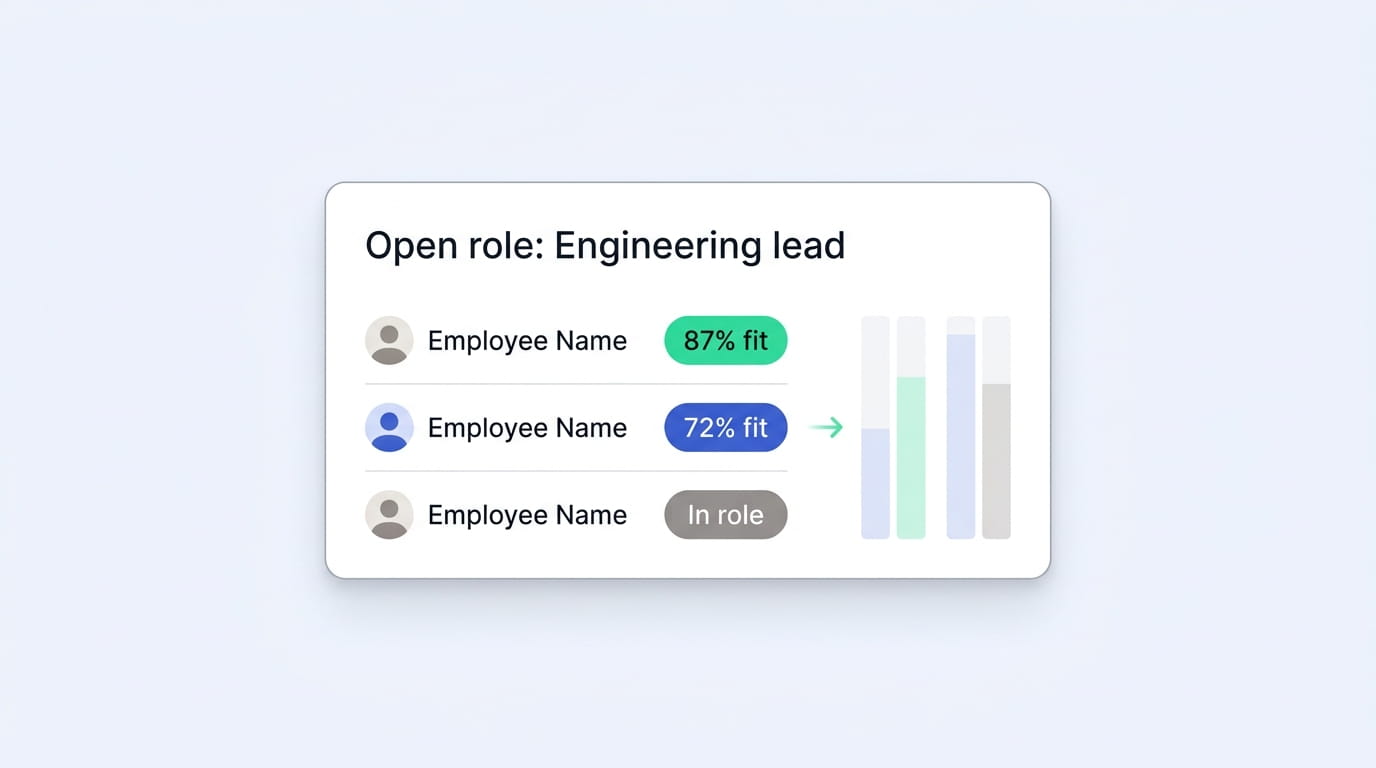
Our internal talent marketplace software helps you match employees to opportunities based on real skills, not just résumés.
Why Internal Mobility Matters
The case for internal mobility is not just cultural. It shows up directly in retention numbers.
The Retention Gap Is Large
Research on internal mobility consistently finds a large retention gap: employees at organizations with strong internal mobility stay roughly twice as long (around 5.4 years, compared to about 2.9 years at organizations without it).
Career Development Is the Top Retention Lever
Surveys of the workforce repeatedly find that a lack of career development is the single most cited reason employees leave, while the large majority say they would stay longer at an organization that visibly invests in their growth.
High-Mobility Organizations Look Structurally Different
Organizations with strong internal mobility report significantly higher internal fill rates for open roles than low-mobility organizations, often around 60% versus roughly 35%, because managers actively support employees moving, rather than quietly blocking transfers to protect headcount.
It Reduces Hiring Cost and Risk
An internal move comes with a known quantity: existing performance history, cultural fit and institutional knowledge. External hiring, by comparison, carries a much higher failure rate and a much longer ramp-up time.
The Components of a Working Internal Mobility Program
Internal mobility does not happen just because leadership says it should. It needs specific building blocks.
Real Skills Visibility
You cannot match people to opportunities you cannot see. That means skill data that goes beyond job titles: current levels, self- and peer-assessed, kept up to date.
Transparent Role Requirements
Employees need to see what a role actually requires before deciding whether to pursue it: not a vague job posting, but the specific skills and levels expected.
A Way to Surface Opportunities, Not Just Search for Them
The best internal mobility programs do not just let employees search open roles; they proactively surface people who are already a strong fit for an opening, even if they never applied.
Manager Buy-In
Internal mobility fails quietly when managers treat a transfer request as a threat to their headcount rather than a win for the organization. Programs that work make the trade explicit and visible at a leadership level.
Practical Tips for Building Internal Mobility
Make Skills, Not Job Titles, the Unit of Matching
Two people with the same job title can have very different skill profiles, and two very different titles can share the exact skills a new role needs. Match on skills.
Publish Requirements, Not Just Openings
An open role with no visible skill requirement invites guesswork. Publishing what a role actually needs turns internal applications from a lottery into an informed decision.
Track the Metric Leadership Actually Cares About
Internal fill rate (the share of open roles filled internally rather than externally) is a clean, trackable signal of whether internal mobility is working or just being talked about.
The Role of Software in Internal Mobility
Spreadsheets and job boards cannot connect a person’s real, current skill profile to every open role across the organization at once. That only becomes possible when skills, roles and availability live in the same system.
This is exactly what agyleOS’s internal talent marketplace does: it matches employees to opportunities based on live skill data, not a static résumé, and pairs that with a career pathing view so employees can see, and work toward, roles they are not quite ready for yet. Read more about the full internal talent marketplace platform.
To Sum Up
Internal mobility is not a perk or a nice-to-have HR initiative. It is one of the most reliable retention levers available, and it is systematically underused: only a small share of organizations prioritize it, despite the data showing it is the single largest lever for keeping people.
The organizations that get it right do not rely on employees stumbling onto the right opportunity. They make skills visible, requirements transparent, and the path from where someone is to where they could be, obvious.
By submitting this form, I confirm that I have read the privacy policy and that I consent to the processing of my personal data by agyleOS for the purposes stated. In the event of consent, I can revoke my consent at any time. Furthermore, by submitting the form, I agree to the general terms and conditions.


- Product
- Skill Management
- Interactive Org Charts
- Skill Matrix
- Performance Reviews
- Skills Gap Analysis
- Competency Management
- Employee Surveys
- Talent Management
- Team Builder
- Kudo wall
- Organizational Culture
- Internal Talent Marketplace
- Employee Development Software
- Employee Skills Inventory
- Team capacity planning
- Career pathing
- Certificate management
- Succession planning
- Personio Integration
- Resources
- Consulting
- Blog
- Walkthrough
- Events
- API documentation
- Compare
- Company