

What Is Certificate Management? A 2026 Guide for HR Teams


- Why Certificate Management Matters
- The Components of a Solid Certificate Management Process
- Practical Tips for Managing Employee Certifications
- The Role of Software in Certificate Management
- To Sum Up
Ask any HR manager how confident they are that every safety-critical certification in their organization is current, and you will usually get a pause before the answer.
Certificate management is the practice of tracking, verifying and renewing the professional credentials, licenses and training certificates your employees hold, and connecting that record to the roles that actually require them.
Done well, it turns a scattered mix of PDFs, spreadsheets and institutional memory into a single, reliable source of truth. Done poorly, or not at all, it becomes a compliance risk that surfaces at the worst possible moment: during an audit, a client review, or after an incident.
Our certificate tracking software keeps every credential visible, current and connected to the roles that need it.
Why Certificate Management Matters
Certificate management is not a paperwork exercise. It sits at the intersection of compliance, staffing confidence and employee development.
Compliance and Risk Reduction
Many industries (healthcare, aviation, construction, finance, manufacturing) legally require certain certifications for certain tasks. Losing track of an expired certification is not just an administrative gap; it can mean regulatory exposure, failed audits or, in safety-critical settings, real harm.
Client and Audit Confidence
When a client or regulator asks who on your team is certified for a specific task, the answer needs to take seconds, not days. Organizations that can produce this instantly project competence. Those that cannot raise doubts, even if the underlying work is solid.
Better Workforce and Project Planning
Certificate data is staffing data. Knowing exactly who holds a required credential lets you assign the right person to the right project without a round of confirmation emails, and lets you spot capacity gaps before a deadline forces the issue.
Employee Development
Certifications are also a visible marker of growth. Tracking them alongside skill levels gives employees and managers a fuller picture of where someone stands, and what is worth pursuing next.
The Components of a Solid Certificate Management Process
A handful of building blocks separate organizations that manage certifications well from those that discover problems too late.
Certificate Inventory
The foundation is a complete, current record of who holds what: issuing body, issue date, and scope. Without this baseline, nothing else in the process works.
Expiry and Renewal Tracking
Certifications lapse. A functioning process surfaces upcoming expirations early enough to schedule renewal training, rather than discovering a gap only once it has already caused a problem.
Linking Certificates to Role Requirements
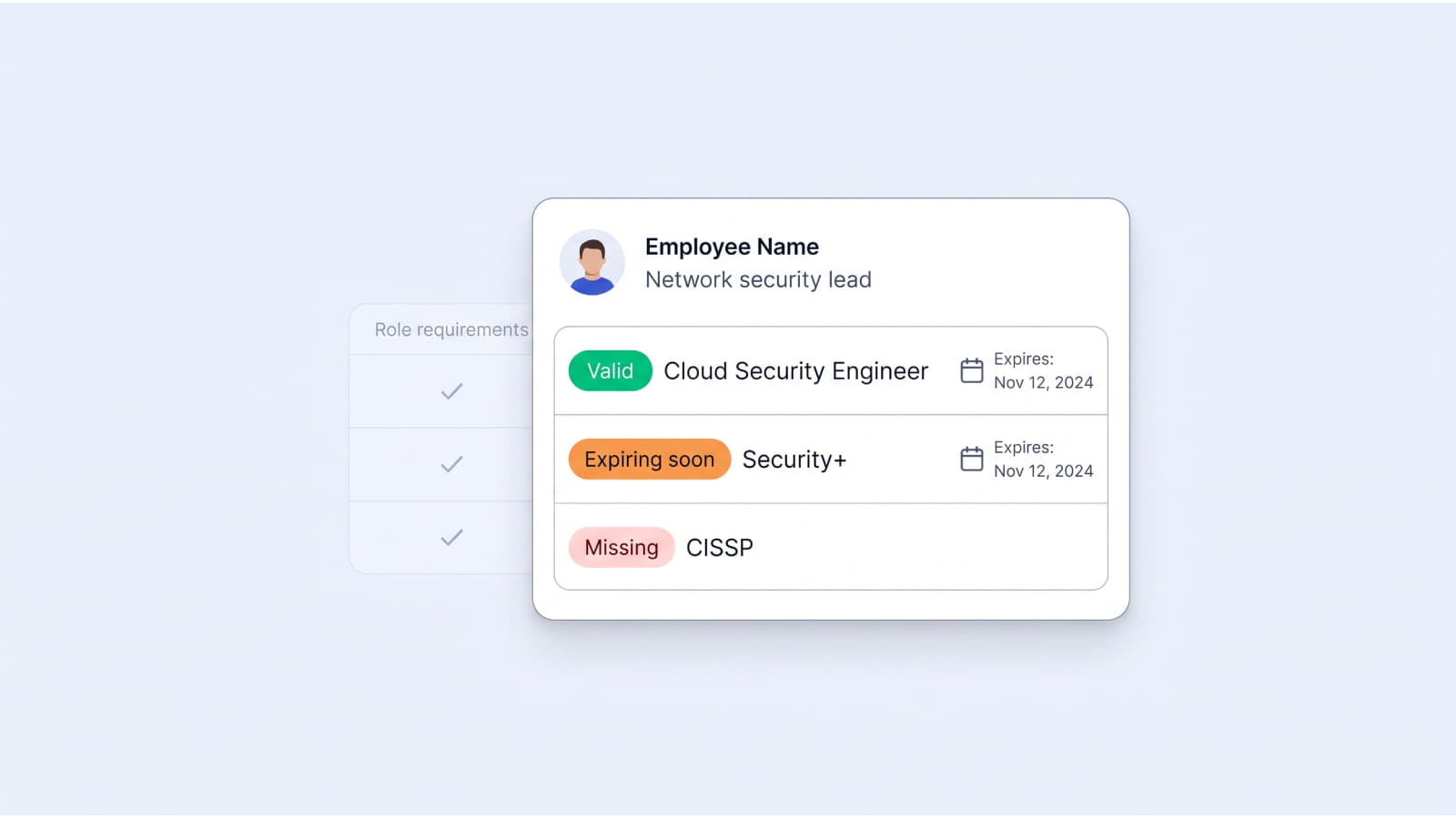
A certificate only matters in context. The real value comes from connecting each credential to the roles and tasks that require it, so gaps between “who holds this role” and “who is actually qualified” become visible automatically.
Reporting and Visibility
HR, managers and, where appropriate, clients or auditors all need different views of the same underlying data, from a full compliance export to a quick check on a single project team.
Practical Tips for Managing Employee Certifications
Centralize, Do Not Scatter
Every certificate that lives in a personal folder, a departmental spreadsheet, or someone’s memory is a certificate that will eventually be forgotten. Centralizing records, ideally alongside the skills and role data you already track, removes an entire category of risk.
Tie Certificates to Role Requirements, Not Just People
Tracking who has a certificate is only half the job. Defining which roles require it, and at what renewal cadence, is what turns tracking into actual risk management.
Review on a Cadence, Not Just at Audit Time
Waiting for an audit to check certificate status guarantees you will occasionally find out too late. A regular review cadence, monthly or quarterly, depending on your industry, catches gaps while there is still time to close them.
The Role of Software in Certificate Management
Spreadsheets can technically track certificates. What they cannot do is connect that data to skills, roles and team structure, or surface a gap automatically the moment a role’s requirements are not met.
A platform like agyleOS keeps certificates in the same employee profile as skills and role assignments, so a missing or expiring credential shows up exactly where staffing and development decisions are actually made, not in a separate report nobody opens until it is too late.
To Sum Up
Certificate management is not glamorous, but it is one of the few HR processes where getting it wrong has immediate, visible consequences: a failed audit, a client question you cannot answer, a task assigned to someone who should not have been doing it.
Getting it right does not require more paperwork. It requires putting certificate data where your skill and role data already lives, so the two inform each other automatically.
By submitting this form, I confirm that I have read the privacy policy and that I consent to the processing of my personal data by agyleOS for the purposes stated. In the event of consent, I can revoke my consent at any time. Furthermore, by submitting the form, I agree to the general terms and conditions.


- Product
- Skill Management
- Interactive Org Charts
- Skill Matrix
- Performance Reviews
- Skills Gap Analysis
- Competency Management
- Employee Surveys
- Talent Management
- Team Builder
- Kudo wall
- Organizational Culture
- Internal Talent Marketplace
- Employee Development Software
- Employee Skills Inventory
- Team capacity planning
- Career pathing
- Certificate management
- Succession planning
- Personio Integration
- Resources
- Consulting
- Blog
- Walkthrough
- Events
- API documentation
- Compare
- Company